Troubleshooting
Resetting a Samsung Ice Maker: Five Cabinets, Five Procedures
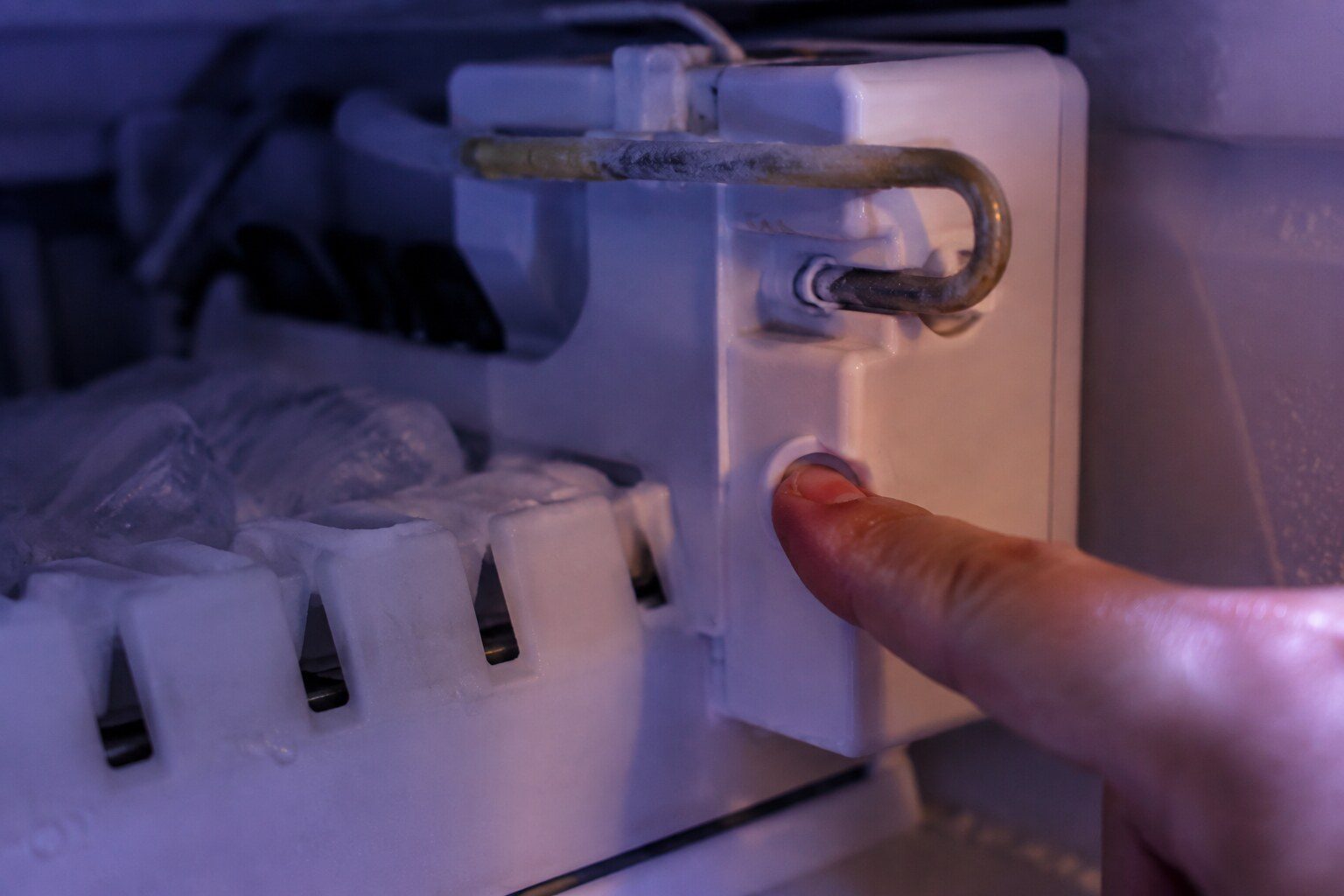
Samsung puts the ice maker in five different places depending on the cabinet — the fresh-food compartment, the back of the freezer door, the bottom of a bottom-freezer, the top of a top-freezer, and a dedicated assembly on cabinets that make both cubed ice and Ice Bites — and it publishes a separate reset procedure for each. They are not interchangeable, and using the wrong one usually does nothing at all, which looks like a machine that will not reset. Identify the layout first. Then, before pressing anything, rule out the two things a reset cannot fix: a bucket that is not seated, which stops production entirely and shows as a blinking Ice Off indicator, and a compartment that is not cold enough, which starves a healthy ice maker. After a reset, give the machine a full twenty-four hours. The first harvest cycles are slow and judging it after two hours is how people conclude a working machine is dead.
The full guide
How do I reset my Samsung refrigerator ice maker? Why there are five of them
Nothing else in this fleet has this shape, and it is worth understanding rather than working around.
Samsung does not put its ice makers in one place. Depending on the cabinet, the ice maker lives:
- in the fresh-food compartment, behind a small panel, fed by a duct of cold air from the freezer;
- in the back of the freezer door, with its own compartment and its own seal;
- in the bottom of a bottom-freezer cabinet;
- in the top of a top-freezer cabinet;
- or as a dedicated assembly on the cabinets that make both cubed ice and Ice Bites.
Those are genuinely different machines. Different fill paths, different sensors, different mechanisms for pushing the ice out, and — because they are different — different reset procedures, which Samsung publishes as five separate articles.
The reset button is in a different place on each. The hold time differs. On some the test cycle is initiated by a button behind the bucket; on others by a lever; on others by a sequence on the panel.
Which one do you have?
Open the doors and look before you touch anything.
Ice dispensed through the door, bucket inside the door. In-door ice maker. It has its own small compartment with a seal against the fresh-food side and, on many cabinets, its own small fan — Samsung's 40E.
Bucket in the fresh-food compartment, usually behind a hinged panel near the top. The fridge-compartment layout, fed by a duct from the freezer. This is the one most affected by a cabinet packed full, because it depends on air arriving from elsewhere.
Bucket in the freezer drawer or the freezer compartment. The simplest arrangement, and the one where the fill tube and its heater matter most.
Two kinds of ice. A second assembly, with its own procedure.
Naming that layout is the first genuinely useful thing an owner can do, on this appliance more than any other, and it is the first thing we ask on the phone.
Two things a reset cannot fix
Before you press anything, rule these out, because a reset will not touch either and people spend a week on the wrong thing.
A bucket that is not seated. If the cabinet cannot see the bucket, it stops making ice entirely — and it says so, with a blinking Ice Off indicator. Take the bucket right out, check nothing is behind it, and push it home until it seats. This is free, it is common, and it usually happens the day after somebody emptied it into a cooler.
A compartment that is not cold enough. Ice production is driven by temperature. A compartment that has drifted up a few degrees will starve a perfectly good ice maker, and it will not feel warm to a hand. Put a thermometer in it and give it an hour. Around 0°F is what an ice maker needs.
Resetting an ice maker in a warm compartment gets you a reset ice maker in a warm compartment.
What a reset actually does
It runs a test cycle. The machine harvests whatever is in the mold, fills, and starts again from a known state.
That helps in a specific set of circumstances: when the mechanism has stopped partway through a cycle, when a sensor has latched on a reading that is no longer true, or after the machine has been unplugged and has come back confused. It is genuinely useful for those.
It is not a repair, and it does not make anything colder, warmer, cleaner or less frozen. If the mechanism is jammed with ice, a reset will try to harvest into that ice and stop.
After the reset: wait a day
This is where more of these calls go wrong than anywhere else.
The compartment has to be at temperature before the machine will make ice at a normal rate, and the first harvest cycles are deliberately slow. A machine that has produced nothing in two hours may be perfectly healthy.
Give it twenty-four hours before drawing any conclusion. If there is ice in the bucket the next day, you are done. If there is a little, it is working and catching up. If there is none at all, then you know something.
When the reset works for exactly a day
This pattern comes up often enough to name, and it is not a coincidence: the ice maker resets, produces ice for about a day, and stops again.
That is usually the fill tube freezing shut. Samsung wraps a small heater around the tube that feeds the ice maker, precisely to stop that happening, and publishes 33E for it. When the heater stops working, the tube freezes between fills, and clearing or resetting gets you exactly one good cycle before it happens again.
It is a much smaller repair than an ice maker and it is worth mentioning on the phone, because the pattern is the diagnosis.
No codes, and what that means
Samsung publishes error codes for refrigerators, dishwashers, washers, dryers, ranges, ovens and microwaves. For ice makers it publishes none at all.
The related codes that exist — 8E and 14E for the sensors, 33E for the fill tube heater, 39E for the mechanism, 40E for the ice room fan — are on the refrigerator table, because that is the appliance they belong to. If your cabinet has shown any of them, read them to us: on an appliance with no table of its own, a code from the cabinet it lives in is the closest thing to a direct answer available.
Everything else is read from behavior, which is why the five layouts matter, why the pattern of when it stops matters, and why we ask more questions on the phone about this appliance than about any other on this make.
Questions people ask about this
How do I know which layout I have?
Open the doors and look. If the ice comes out of the door and the bucket is in the door, it is an in-door unit. If the bucket sits in the fresh-food compartment behind a small panel, that is the fridge-compartment layout. Otherwise it is in whichever freezer your cabinet has — bottom or top — and the cabinets that make two shapes of ice have a second, separate assembly.
Is there any harm in trying the wrong reset?
Generally no, which is its own problem: nothing happens, and people conclude the machine is unresponsive. It is worth identifying the layout first rather than working through all five.
How long before I should expect ice?
A full day. The compartment has to be at temperature and the early harvest cycles are slow, so a machine that produces nothing in two hours may be perfectly healthy and simply catching up.
It resets, makes ice for a day, then stops again.
That pattern is diagnostic and it is usually the fill tube re-freezing, which points at the small heater Samsung publishes 33E for. A reset that works for exactly a day is not a coincidence.
Troubleshooting
More guides like this one
-
Before You Call Anyone About a Warm Refrigerator, Check for a Mode
Samsung has a mode that lights the whole panel and does not cool. It gets switched on at home by accident, it is free to clear, and it produces the most alarming symptom an appliance can produce.
Read more -
A Microwave That Runs and Does Not Heat, and the Honest Arithmetic
The diagnosis is quick. The decision is not — because the same failure has three different prices depending on where the appliance sits.
Read more -
A Dryer That Tumbles Cold: What to Check, in Order
There is very little to reset. But there is one electrical case that gives you a dryer which tumbles perfectly and makes no heat at all — and it is not the appliance.
Read more
Tell us the model number and what it is doing.
This article is based on:
- Official manufacturer documentation
- Internal repair procedures
- Technician repair history
- Company quality standards