Troubleshooting
A Microwave That Runs and Does Not Heat, and the Honest Arithmetic
Confirm it first with a mug of cold water on full power for a minute: noticeably warmer means the machine is heating and the complaint is something else. Unchanged means the high-voltage side — the magnetron, the diode, the capacitor or the transformer — or a door interlock that is preventing it from firing. That is not an owner repair under any circumstances, because the capacitor holds a lethal charge after the appliance is unplugged and does not bleed off quickly. The repair-or-replace answer depends entirely on the installation. A countertop unit out of warranty often is not worth it, and we say so on the phone. An over-the-range unit usually is, because replacing it means an installation, a cabinet cut-out that may not match, and re-doing the vent. The microwave half of a combination wall oven cannot be replaced on its own at all, so repair is effectively the only route.
The full guide
How do I fix my Samsung microwave that won't heat? Confirm it before anything else
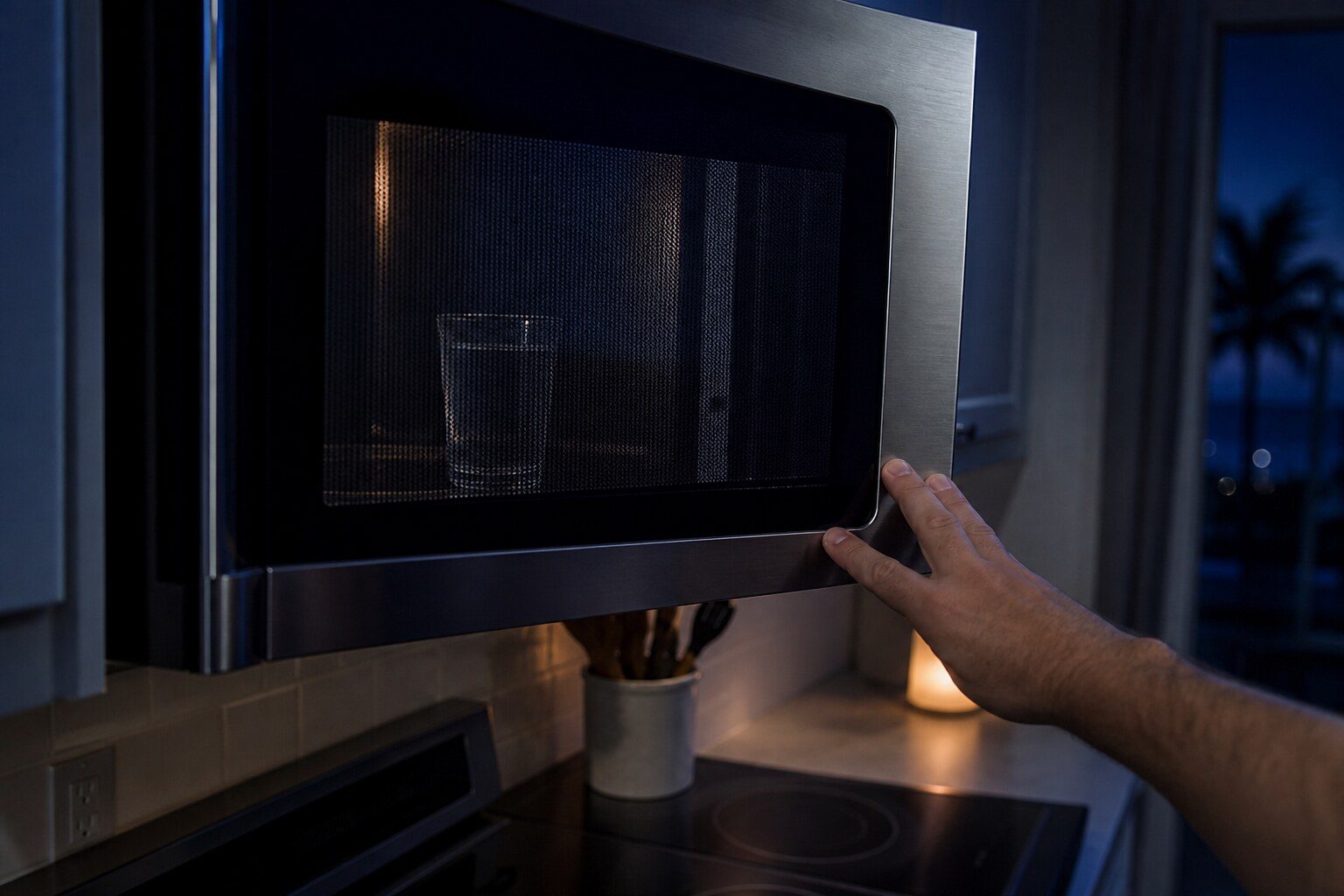
Put a mug of cold water in, run it for a minute at full power, and touch the mug.
Noticeably warmer means the machine is heating, and the complaint is something else — food heating unevenly, a turntable that has stopped, or a power level that has been left low. Power level is worth checking properly: it is a setting, it stays where it was left, and a microwave on 30% heats very slowly while behaving perfectly normally.
Unchanged after a minute means the high-voltage side, and that is where this page goes.
Two separate circuits in one cabinet
This is the bit that confuses people, and it explains why a microwave can look completely alive and do nothing.
The low-voltage side runs the display, the keypad, the turntable motor, the interior light and the cooling fan. When that is working, the machine lights up, beeps, counts down and turns the plate. It looks entirely healthy.
The high-voltage side is what actually produces microwaves. A transformer steps the mains up to thousands of volts, a capacitor and a diode double and rectify it, and a magnetron converts that into the radiation that heats food. It is a separate circuit, switched by the control when a cycle starts.
So a machine that runs, lights, turns and beeps while producing no heat at all is not a contradiction. It is the low-voltage side working and the high-voltage side not.
The safety line we do not soften
The capacitor in a microwave stores enough energy to kill, it holds that charge after the appliance is unplugged, and it does not bleed away quickly enough to make waiting a strategy.
That is not a sales position and it is not liability language. It is the reason microwave repair is done by people with a discharge tool and a habit of using it before touching anything.
There is no version of this repair that is a reasonable home project. If you take one thing from this page, take that one.
Where the appliance sits decides the answer
The same failure has three very different prices, and it has nothing to do with how the microwave broke.
A countertop unit. A standalone appliance you can lift with two hands. Out of warranty, with a high-voltage failure, the repair frequently approaches the price of a comparable new machine — and we will tell you that on the phone rather than after a visit. It is the one repair on this site we routinely talk people out of.
An over-the-range unit. Now it is not just a microwave. It is also the cooktop's ventilation, the cooktop's light, and a unit screwed to the wall and to the cabinet above it. Replacing it is a two-person job with a real chance that the new one does not match the existing cut-out or the existing duct arrangement. Against that, a repair is usually the better arithmetic by a wide margin.
The microwave half of a combination wall oven. This cannot be replaced on its own. The cabinet is one appliance with one control platform, and the microwave section is part of it. Repair is effectively the only route, and it is virtually always worth doing.
What else produces a cold microwave
Not everything here is the magnetron, and two of the alternatives are considerably cheaper.
A door interlock. A microwave has several switches that confirm the door is closed, and they have to agree with each other before the high-voltage side is allowed to fire. If they disagree — because one has failed, or because the door is slightly out of alignment after being closed hard for ten years — the machine runs and refuses to heat. Samsung reports the related conditions in its C-d family, and this is a repairable and reasonably priced fix.
The control board. Samsung's C-F family: a communication error between parts of the electronics. The machine runs a cycle and never calls for power. On a combination wall oven this can present as the whole cabinet behaving oddly, because both halves share a control.
Those two are worth eliminating before anybody talks about a magnetron, and they are why we measure rather than assume.
The codes are unusually detailed here
Samsung publishes about fifty codes for its microwaves — more than for any other appliance it makes — and they are grouped by what is reporting rather than by severity. The C- families are sensors and communication: gas or PH sensing, temperature, steam, door and key, communication. The E- families are longer and more specific, from open errors and cooking-time limits through weight sensing to the memory and communication codes in the E-5x and E-8x ranges.
On this table the digit genuinely matters. E-21 and E-24 are both temperature conditions and they mean different things, and reading one as the other sends a technician somewhere unhelpful.
So if there is a code, read it out character by character. On this appliance more than any other on the make, it names the part.
Two things not to do
Do not run it empty to test it. A microwave with nothing in it has nowhere to put the energy it produces, and that damages the magnetron. If you want to test whether it heats, use a mug of water.
Do not keep trying it. A machine that has failed on the high-voltage side is not going to recover, and repeated attempts stress the components that have not failed yet.
What we do
Confirm the failure with a measured load. Check the door interlocks and the keypad first, because they are cheaper and they produce the same symptom. Then discharge the capacitor and test the high-voltage components properly — transformer, capacitor, diode, magnetron — rather than replacing the expensive one on suspicion.
And then we tell you the number, with the honest version of the arithmetic attached, before anything is ordered.
Questions people ask about this
It heats sometimes and not others.
Intermittent heating points at a door interlock or a connection rather than the magnetron, which tends to fail and stay failed. Worth mentioning, because it changes what gets tested first.
There was a bang and a smell.
Stop and unplug it. That is usually the diode or the capacitor, and the smell is what it sounds like. It is not dangerous to the room, but it is finished as a repair-it-yourself proposition, if it ever was.
Why can I not just replace the magnetron myself?
Because of what sits next to it. The high-voltage capacitor in a microwave stores enough energy to be lethal after the machine has been unplugged, and it does not discharge on its own within any timeframe you would find reassuring. Discharging it safely takes a tool and a procedure.
The turntable turns and the light works, so surely it has power?
It does. The turntable, the light and the fan run on the low-voltage side, which is entirely separate from the circuit that produces microwaves. A machine that looks completely alive and does not heat is exactly what a high-voltage failure looks like.
Troubleshooting
More guides like this one
-
Resetting a Samsung Ice Maker: Five Cabinets, Five Procedures
Samsung publishes five different reset procedures, one for each place it puts an ice maker. They are not interchangeable — and a reset is the wrong move more often than people think.
Read more -
Before You Call Anyone About a Warm Refrigerator, Check for a Mode
Samsung has a mode that lights the whole panel and does not cool. It gets switched on at home by accident, it is free to clear, and it produces the most alarming symptom an appliance can produce.
Read more -
A Dryer That Tumbles Cold: What to Check, in Order
There is very little to reset. But there is one electrical case that gives you a dryer which tumbles perfectly and makes no heat at all — and it is not the appliance.
Read more
Tell us the model number and what it is doing.
This article is based on:
- Official manufacturer documentation
- Internal repair procedures
- Technician repair history
- Company quality standards