Common Problems
No Ice, But the Water Dispenser Works: What That Narrows It To
Water at the dispenser proves the supply line, the inlet valve and the filter are all doing their job, because the ice maker is fed through the same path. That removes half the usual list. What is left is the ice maker itself, the fill tube that feeds it, the compartment temperature, and whether the ice maker has simply been switched off or its bucket left unseated. Check the bucket first — take it out and push it firmly back until it seats, and look for a blinking Ice Off indicator, which means exactly that. Then check the ice maker is switched on in the panel settings. Then look at the fill tube for a visible plug of ice, which is a small heater rather than a new ice maker. Only after those is it the module or its sensor. Samsung publishes no error codes for ice makers at all, so what the machine is doing is the whole diagnosis.
The full guide
Samsung ice maker not making ice but water works: why this particular sentence is worth typing
Most appliance complaints are vague. This one is not, and it is doing more work than the person typing it usually realizes.
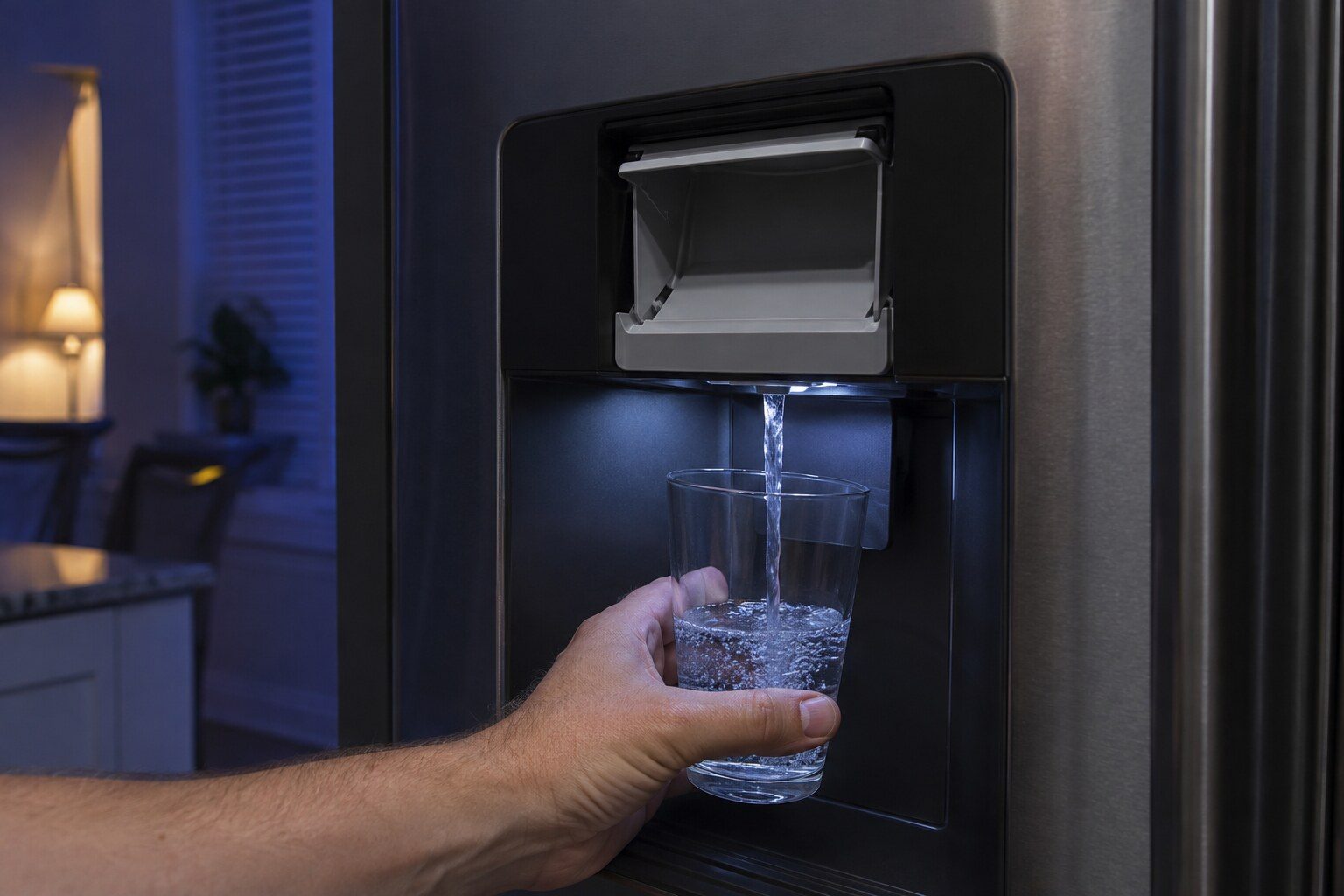
A Samsung refrigerator feeds its ice maker and its water dispenser from the same line. The water comes into the back of the cabinet through one shut-off valve, through one filter, through one inlet valve, and then splits — one branch to the dispenser in the door, one to the ice maker. So water arriving at the dispenser, at normal pressure, proves that all of the shared part of that path is working.
That removes the supply, the filter and the inlet valve from the list in a single observation, and those three are the most common causes of no ice on almost every other make.
What is left is short.
The two free checks
The bucket. Take it right out, look at whether anything is jammed behind it — a stray cube, a piece of packaging — and push it back in until it seats properly. On a cabinet that cannot see its bucket, Samsung blinks an Ice Off indicator and stops production entirely. Nothing is wrong with the machine. It is the single most common no-ice call that is not a repair at all, and it usually happens the day after somebody emptied the bucket into a cooler and put it back at a slight angle.
The switch. On current cabinets the ice maker is turned on and off in the panel settings rather than by a lever, and it is easy to hit while cleaning or while a child is exploring the display. If the panel says Ice Off, that is not a diagnosis, it is an instruction somebody gave it.
Between them those two account for a real share of the calls we take on this. Both take under a minute and neither costs anything.
The fill tube, and the small heater around it
If the bucket is seated and the ice maker is on, the next thing to look at is the tube that fills it.
Samsung wraps a small heater around that tube, and the heater has exactly one job: to stop the tube freezing shut between fills. Water sits in the end of it after every fill, in a compartment below freezing, and without the heater it turns to a plug of ice that blocks the next fill. Samsung publishes a code for that heater — 33E — on the refrigerator table.
What makes this worth checking early is the price. A frozen fill tube looks identical to a dead ice maker: no ice, no noise, nothing happening. But it is a heater and a clearing, not an assembly.
You can often see it. Depending on the cabinet, the tube enters the ice compartment at the back or the top, and a plug of ice at the end of it is visible without taking anything apart. If clearing it gets you ice for a day and then it stops again, that is the heater rather than luck.
Temperature, which is easy to be wrong about
Ice production is driven by how cold the compartment is, and a compartment that has drifted up by a few degrees will starve a perfectly good ice maker without ever feeling warm.
That is why a thermometer matters more here than a hand. A freezer should be sitting around 0°F. Put a thermometer between packages rather than against a wall, leave it an hour, and read it. If it is at 10°F, the ice maker is not the problem — the cabinet is, and you have a different page to read.
This is also where an in-door ice maker differs from one in the freezer. Cabinets that make ice in the fresh-food door keep that compartment cold with a small fan of its own — Samsung's 40E — and that compartment can be warm while the freezer below it is perfectly fine. If your ice maker is in the door and the ice is soft, or wet, or arriving as one lump, look there.
What Samsung does not publish, and what that means for you
There are no error codes for ice makers. None. Samsung publishes tables for refrigerators, dishwashers, washers, dryers, ranges, ovens and microwaves, and nothing at all for ice makers, freezers or range hoods.
Two consequences follow, and they are worth saying plainly.
The first is that any site offering you a list of Samsung ice maker error codes has made it up. We would rather tell you that than compete with it.
The second is that the diagnosis has to come from behavior instead — which is exactly why a sentence like "no ice but water works" is worth so much. On an appliance that reports nothing, the shape of what it is doing is the only evidence there is, and the more precisely you can describe it on the phone, the more useful the first visit becomes.
Five layouts, five procedures
If you reach the point of resetting the ice maker, the procedure depends on where it physically sits in your cabinet. Samsung publishes five separate ones: for an ice maker in the fresh-food compartment, one in the back of the freezer door, one in a bottom freezer, one in a top freezer, and one for the cabinets that make both cubed ice and Ice Bites.
They are not interchangeable, and using the wrong one usually does nothing rather than doing harm — which is its own problem, because it looks like a machine that will not reset.
Whichever you use, give it a full day afterwards. The compartment has to come back to temperature and the first harvest cycles are slow. Judging a reset after two hours is how people conclude a machine is dead when it is simply cold and catching up.
When it is worth a visit
When the bucket is seated, the ice maker is on, the compartment measures around 0°F, the fill tube is clear, and there is still no ice after twenty-four hours.
At that point it is the module, its sensor or the small fan that keeps the compartment cold, and those are measured rather than guessed. Samsung's own related codes — 8E and 14E for the sensors, 39E for the mechanism, 40E for the ice room fan — all live on the refrigerator table, and if your cabinet has shown any of them, read them to us. On an appliance with no code table of its own, a code from the cabinet it lives in is the closest thing to a direct answer you will get.
Questions people ask about this
Does water at the dispenser really rule that much out?
It rules out everything upstream of the split. The dispenser and the ice maker are fed from the same line, through the same shut-off valve, the same filter and the same inlet valve on the back of the cabinet. If water arrives at the door under normal pressure, all of those work. That is genuinely half the list, and it is why this is such a useful phrase to type.
How do I know if the ice maker is switched off?
It is a setting on the panel rather than a physical switch on most current cabinets, usually called Ice Off or Ice Maker. On some models the indicator blinks when the bucket is not seated, which reads as the same thing. Both are free to correct and both stop production completely, which is why they come before anything else.
How long after a reset should I wait?
A full day. The compartment has to be at temperature and the first harvest cycles are slow. Judging it after two hours is how people end up paying for a machine that was already recovering.
The ice maker feels cold but nothing is happening.
Cold is not the same as cold enough. Ice production is driven by temperature, and a compartment that has drifted up a few degrees will starve a perfectly healthy ice maker without ever feeling warm to a hand. Put a thermometer in it rather than trusting the panel.
Common Problems
More guides like this one
-
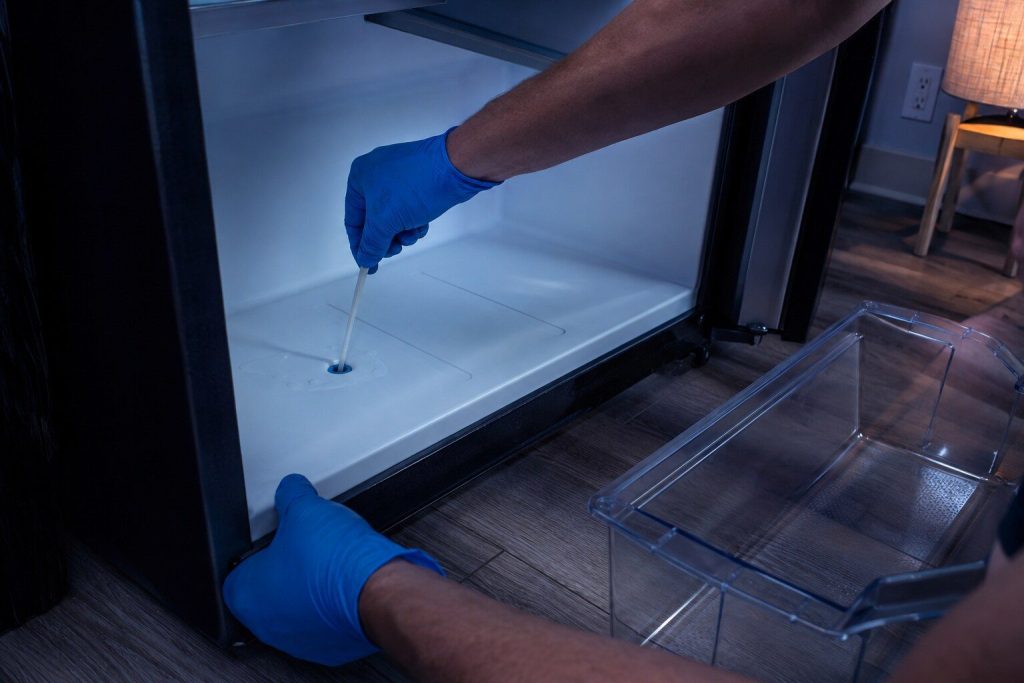
Water Under the Crisper Drawer, and the Small Blocked Tube Behind It
Water in that exact place is almost never the water line and almost never the filter. It is melt water that cannot get out, and the tube it should be leaving by has frozen shut.
Read more -
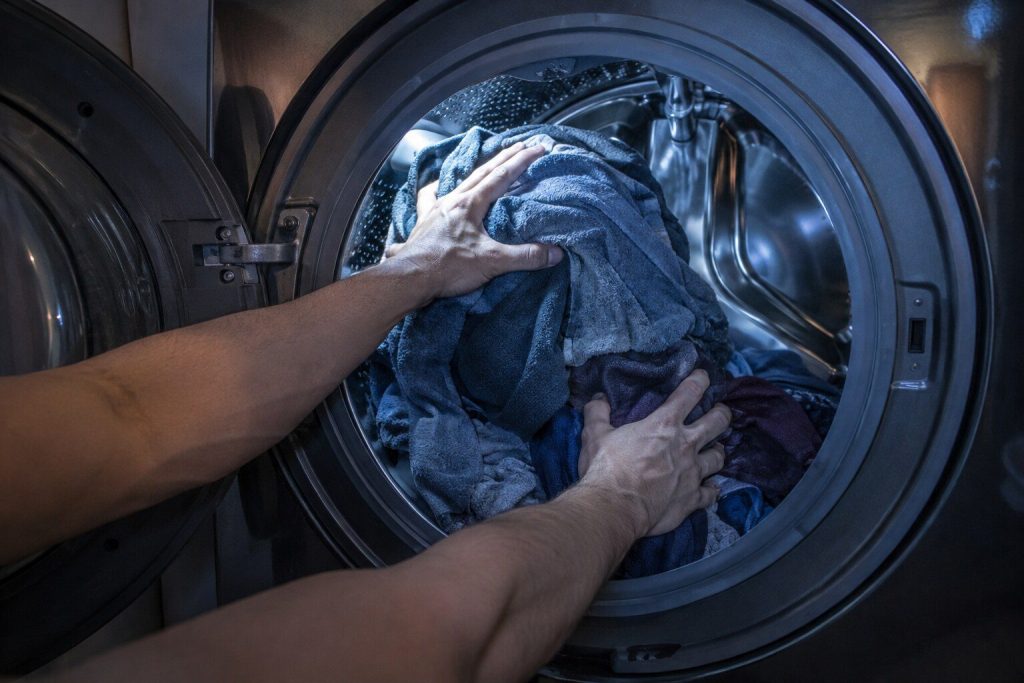
A Washer That Will Not Spin: Is It the Load or the Machine?
Ten minutes and three towels settle it. Samsung's Ub and Ur codes mean the machine has decided the load cannot be spun safely — and most of the time it is right about the laundry.
Read more -
An Oven That Turns Itself On, and the Three Explanations
Three causes, and two of them are free to rule out. The third is worth acting on the same day, because an oven that heats without being asked is not a thing to live with.
Read more
Tell us the model number and what it is doing.
This article is based on:
- Official manufacturer documentation
- Internal repair procedures
- Technician repair history
- Company quality standards