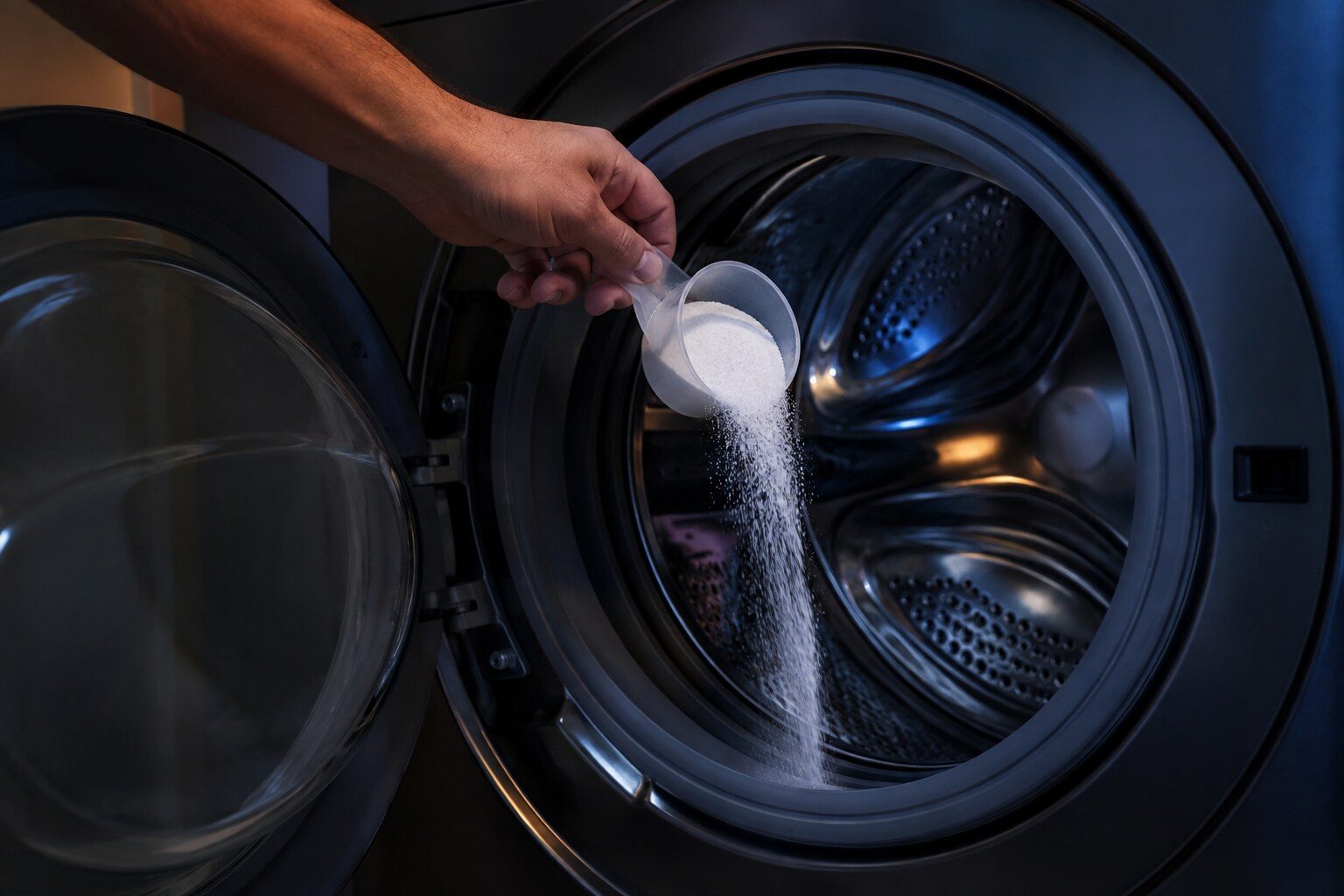
Maintenance & Prevention
How Often a Samsung Washer Actually Needs Its Drum Cleaned in Florida
Run Self Clean when the machine asks — the reminder appears after a set number of washes — and in South Florida treat that as a minimum rather than a schedule. Monthly is reasonable for a household doing several loads a week. But the cycle only cleans the drum, and the smell people run it to remove almost always lives somewhere it does not reach: the folds of the door boot, the debris filter behind the lower panel, and the housing behind the detergent drawer. Those three are done by hand, once, and then kept up. The habits matter more than the cycle: leave the door and the dispenser drawer ajar between washes, use less detergent than looks right and make sure it is HE, and wipe the boot dry after the last load of the day. A front loader in this climate is the hardest case in the country for this, and almost all of it is habit rather than parts.
The full guide
How often should I drum clean my Samsung washing machine? Why the manual's interval is not the answer here
Every front-load washing machine manual gives a drum-clean interval, and every one of them was written for a global average laundry room.
South Florida is not that. A laundry room here sits at seventy to eighty-five percent relative humidity for most of the year, often with no window and no extraction, and frequently inside the conditioned envelope of a condo where the air moves very little. Nothing in it dries out on its own — not the drum, not the rubber, not the filter, not the towel on the rail.
So the honest answer to "how often" is: when the machine asks, and if the machine asks less often than monthly, do it monthly anyway. It costs a cycle and it costs nothing else.
What the cycle actually reaches
This is where most of the frustration comes from. People run Self Clean, the smell does not go, and they conclude the cycle does not work.
The cycle works. It cleans the drum — the stainless basket, at high temperature, with a lot of water movement and no laundry to absorb it.
The smell is almost never in the drum. It is in three places the cycle cannot reach:
The door boot. The rubber bellows that seals the door has a fold in it, and that fold holds water after every wash. It is dark, warm, wet and undisturbed. On a machine that has been in use for a couple of years in this climate, pulling that fold back with a torch is usually the entire diagnosis.
The debris filter. Behind a small panel at the bottom front. It catches lint, coins, hair clips and underwires, and it holds standing water between washes. It is designed to be opened by the owner — there is a small drain hose beside it for exactly that — and in our experience most households have never opened it.
The dispenser drawer housing. The drawer itself is easy to rinse. The cavity behind it, where softener has been setting like glue for two years, is not, and it is always worse than the drawer.
Do those three by hand, once, properly. Then the cycle has something to maintain rather than something to fail at.
The three habits, in order of effect
Leave the door ajar. Not wide open — a couple of inches is enough to let air move. And leave the dispenser drawer pulled out slightly too. This is free, it takes no time, and it is the single most effective thing available. A drum that dries between loads does not develop a smell in the first place.
Use less detergent. This one feels wrong to anybody who learned on an older machine, and it is the biggest lever available. High-efficiency washers use so little water that any excess detergent has nowhere to go — it stays in the machine as residue, and residue is food for exactly what you are trying to remove. Half the dose on the cap is a reasonable starting point for a normal load in soft-ish water, and it will not make anything less clean. Make sure it is marked HE as well: ordinary detergent in an HE machine produces foam that the machine reports as an error and residue that stays behind.
Wipe the boot dry after the last load. Ten seconds with the towel you were about to put in the basket anyway. It breaks the cycle that everything else on this page is trying to break.
What Samsung's reminder actually is
The Self Clean light on a Samsung washer blinks after a certain number of washes. Samsung is explicit that this is a reminder and not an error — nothing is wrong, and you do not need to run the cycle that minute.
It is worth running when it is convenient, though, and it is worth not ignoring for months. In this climate a drum that never gets cleaned develops a smell that is much harder to remove than to prevent, and by the time it is noticeable it has usually taken the boot with it.
The one that is a repair
If the boot is genuinely stained through, perished, or has visible black growth in the rubber rather than on it, cleaning will not recover it. A boot in that state is replaced.
The important caveat: replacing it without changing the habits gets you a clean boot and the same problem in a year. Every boot replacement we do on this make comes with the same three sentences at the end of it, and the households that take them seriously do not see us again for that.
While you are doing all this
Two things worth checking, because you have the filter open and the drawer out anyway.
Where the drain hose sits. Too far into the standpipe and it siphons; not far enough and it can come out under pressure. Samsung publishes a depth for this and it is one of the few installation numbers worth knowing.
Whether the machine is level. Push each corner. If it rocks, level it and tighten the lock nuts on the feet. A machine that moves during a spin is wearing out its own suspension, and it will eventually present as a machine that will not spin at all.
Neither is about smell. Both are five minutes, once a year, and they are what a maintenance visit does when we are there anyway.

Questions people ask about this
Do I add anything to the Self Clean cycle?
No. Samsung's Self Clean runs empty and without detergent, and adding detergent to it works against the point — the cycle is trying to remove residue, not create more. Some households add a manufacturer-approved drum cleaner occasionally, which is fine; ordinary laundry detergent is not.
I have run Self Clean and it did not help.
Then the smell is not in the drum. It is almost certainly in the door boot, the debris filter or the dispenser housing, and none of those is reached by the cycle. Do all three by hand once, then keep the habits, and give it a fortnight.
Why is this worse in Florida?
Because a front loader seals its door to hold water, so the drum and the boot stay damp between loads, and the room they are in is at eighty percent humidity for eight months of the year. Nothing ever fully dries. It is not a defect and it is not specific to Samsung — it is the trade-off that comes with using very little water.
Should I switch back to a top loader?
It is a real trade and some households do. A top loader uses far more water and does not seal, so it dries out between loads and rarely smells. What you give up is water use, spin speed and capacity. We would try the habits for a month first.
Maintenance & Prevention
More guides like this one
-

The Oven Door Is Still Locked After Self Clean. What Now?
The lock releases on temperature, not on time. Which means the answer is usually to wait — and the mistakes people make trying to force it are what turn a wait into a repair.
Read more -
Do You Add Detergent to a Self Clean Cycle? Dishwasher and Washer
Four nearly identical questions in the search data, and the answers are not the same for the two machines. Detergent in the wrong cycle is one of the causes of the smell people run it to remove.
Read more -
No Ice After a Filter Change: The Seating, the Air and the Wait
The cause is nearly always the change itself: a cartridge not quite home, air in the line, or an owner judging the result after two hours instead of a day.
Read more
Tell us the model number and what it is doing.
This article is based on:
- Official manufacturer documentation
- Internal repair procedures
- Technician repair history
- Company quality standards