Maintenance & Prevention
How Long a Samsung Refrigerator Water Filter Really Lasts in South Florida
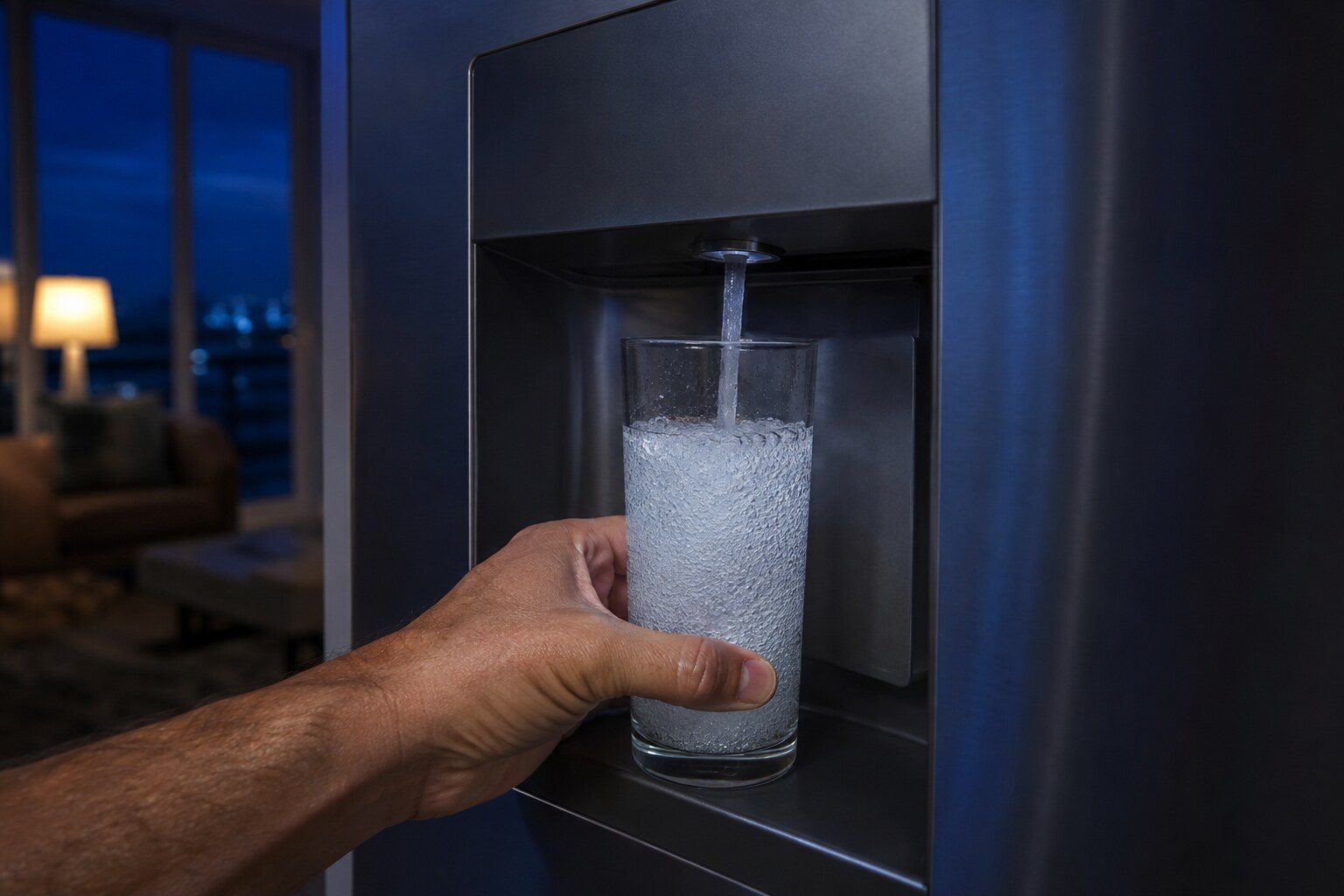
Samsung's stated interval is about six months or a set volume of water, whichever comes first, and the indicator on the panel counts one of those rather than measuring the filter. In South Florida that number is optimistic: the water here is harder and carries more sediment than the average the interval was set against, and households with an ice maker running through the same cartridge get through the volume faster than the calendar suggests. Four to six months is realistic, and a household of five going through a lot of ice may be at the shorter end. What matters more than the number is the symptom, because a filter does not fail suddenly — it restricts. Slow water at the dispenser, ice that has got smaller or slower, or a dispenser that has started to dribble are all a tired cartridge before they are anything else, and all three appear well before the indicator does.
The full guide
How long should a Samsung refrigerator water filter last? What the number on the box is
Six months, or a stated volume of water, whichever arrives first.
That figure is not a measurement of your filter. It is a manufacturer's estimate based on a national average of water quality and household use, chosen so that a cartridge is replaced comfortably before it stops performing for most people.
The indicator on your panel is not a measurement either. It counts — time since the last reset, or liters dispensed, depending on the model — and then lights up. It has no way of knowing what the water has actually done to the cartridge inside.
Both are useful. Neither is the truth about your particular filter.
Why South Florida is harder on them
Two reasons, and they compound.
The water is harder. Municipal supply here carries more dissolved mineral than the average the interval was set against, and hardness is what leaves deposits on everything downstream — the filter media included.
Sediment. Older buildings, long runs of pipe, and periodic work on the mains all put particulate into the supply. A filter's job includes catching that, and a cartridge that has caught a lot of it is restricted well before its calendar life is up.
Add an ice maker fed through the same cartridge — which is most Samsung cabinets — and the volume goes up substantially without anybody noticing, because nobody counts ice.
Four to six months is realistic here. A large household with a heavily used ice maker may genuinely be at the shorter end of that.
The symptoms arrive before the light
This is the practical part, because a filter does not fail. It restricts, gradually, and the effects show up somewhere else.
Water from the dispenser has got slower. The most direct sign, and the easiest to miss because it happens over weeks. If filling a jug takes noticeably longer than it did in the spring, that is your answer.
The ice has got smaller, or slower. Ice production depends on the ice maker filling to a set level in a set time. A restricted supply means it fills less, and the cubes come out thin or hollow. People read that as an ice maker problem and it is a filter problem.
The dispenser dribbles or drips after you let go. Sometimes a restriction, sometimes air in the line, often both.
A taste that has come back. Less common than people assume — carbon media usually gives up on flow before it gives up on taste — but real.
Any of those, with an indicator still showing life, means change the filter first. It is the cheapest thing on the list by a wide margin.
Changing it without causing the next problem
Most of the calls we take about a refrigerator that "started leaking right after a filter change" are about the change rather than the filter.
Seat it properly. A quarter turn, or a firm push to a click, depending on the model. A cartridge that is nearly home will pass water and weep slowly at the head, and that water runs down inside the cabinet where nobody looks for weeks.
Flush it. Several liters through the dispenser, discarded. New cartridges shed carbon fines and hold air, and both cause exactly the symptoms people then call about — gray water, spitting, and an ice maker that fills with air.
Reset the indicator. It is a press and hold on the panel, and if you skip it the count is wrong from then on.
Then wait a day before judging the ice. The compartment has to be at temperature and the early harvests are slow.
The aftermarket question, answered honestly
We fit whatever the customer has bought and we do not sell filters, so there is no position to defend here.
Genuine cartridges are expensive and they seat correctly. Aftermarket cartridges range from excellent to poor, and the variable that matters is not the media — it is the housing. A cartridge whose collar is a fraction off will either refuse to lock, or lock and weep. That is the failure we see, and it is a leak rather than a water-quality problem.
If you buy aftermarket, buy the same one each time. Then you know what a correct fit feels like, and a cartridge that does not feel the same is telling you something.
When it is not the filter
If the filter is new and correctly seated and the water is still slow, the next candidates are the supply — a shut-off valve that is only part open, a kinked line behind the cabinet — and then the inlet valve at the back of the refrigerator.
There is one more that is specific to cold appliances and worth knowing: a frozen line in the door. On cabinets with a through-the-door dispenser, the tube runs through the door where it can be cold enough to freeze if the compartment temperature has drifted. That gives you a dispenser that works in the afternoon and not first thing, which is an odd symptom with a specific cause.
The maintenance case for doing it early
A tired filter costs you flow, and flow costs you ice. But the argument for changing it on schedule rather than on symptom is simpler than that: everything downstream of it — the valve, the fill tube, the ice maker — works harder against a restriction, and those are all considerably more expensive than a cartridge.
It is the cheapest maintenance item on the appliance, and in this water it is the one most worth being early about.

Questions people ask about this
Do I have to use a genuine Samsung filter?
No, and we will fit whatever you have bought. Be aware that aftermarket cartridges vary enormously in how well they seat and how much they restrict, and a filter that does not seat perfectly is one of the most common causes of a refrigerator that suddenly started leaking. If you use one, use the same brand consistently so you know what normal looks like.
Can I run the refrigerator with no filter at all?
Most Samsung cabinets accept a bypass plug and will run happily without one, giving you unfiltered water and ice. Some will not dispense at all without either a filter or the bypass. It is not a long-term arrangement in this water, but it is a legitimate way to find out whether a filter is the cause of a flow problem.
The indicator says the filter is fine and the water is slow.
Believe the water. The indicator counts time or volume from the last reset; it does not measure what is happening at the cartridge. A filter that has met an unusual amount of sediment can be restricting badly with three months showing on the panel.
Ice stopped completely right after I changed the filter.
Very common, and usually the change rather than the filter. Either the cartridge is not fully seated, or air got into the line and the ice maker is filling with air rather than water. Reseat it firmly and run several liters through the dispenser, then give it a full day.
Maintenance & Prevention
More guides like this one
-
The Oven Door Is Still Locked After Self Clean. What Now?
The lock releases on temperature, not on time. Which means the answer is usually to wait — and the mistakes people make trying to force it are what turn a wait into a repair.
Read more -
Do You Add Detergent to a Self Clean Cycle? Dishwasher and Washer
Four nearly identical questions in the search data, and the answers are not the same for the two machines. Detergent in the wrong cycle is one of the causes of the smell people run it to remove.
Read more -
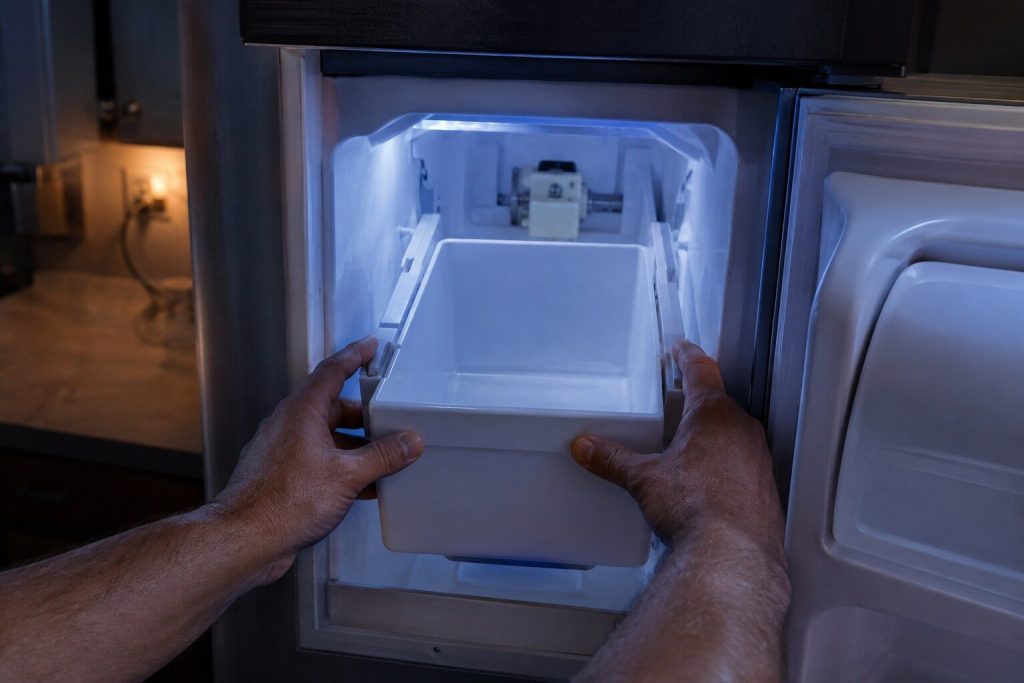
No Ice After a Filter Change: The Seating, the Air and the Wait
The cause is nearly always the change itself: a cartridge not quite home, air in the line, or an owner judging the result after two hours instead of a day.
Read more
Tell us the model number and what it is doing.
This article is based on:
- Official manufacturer documentation
- Internal repair procedures
- Technician repair history
- Company quality standards