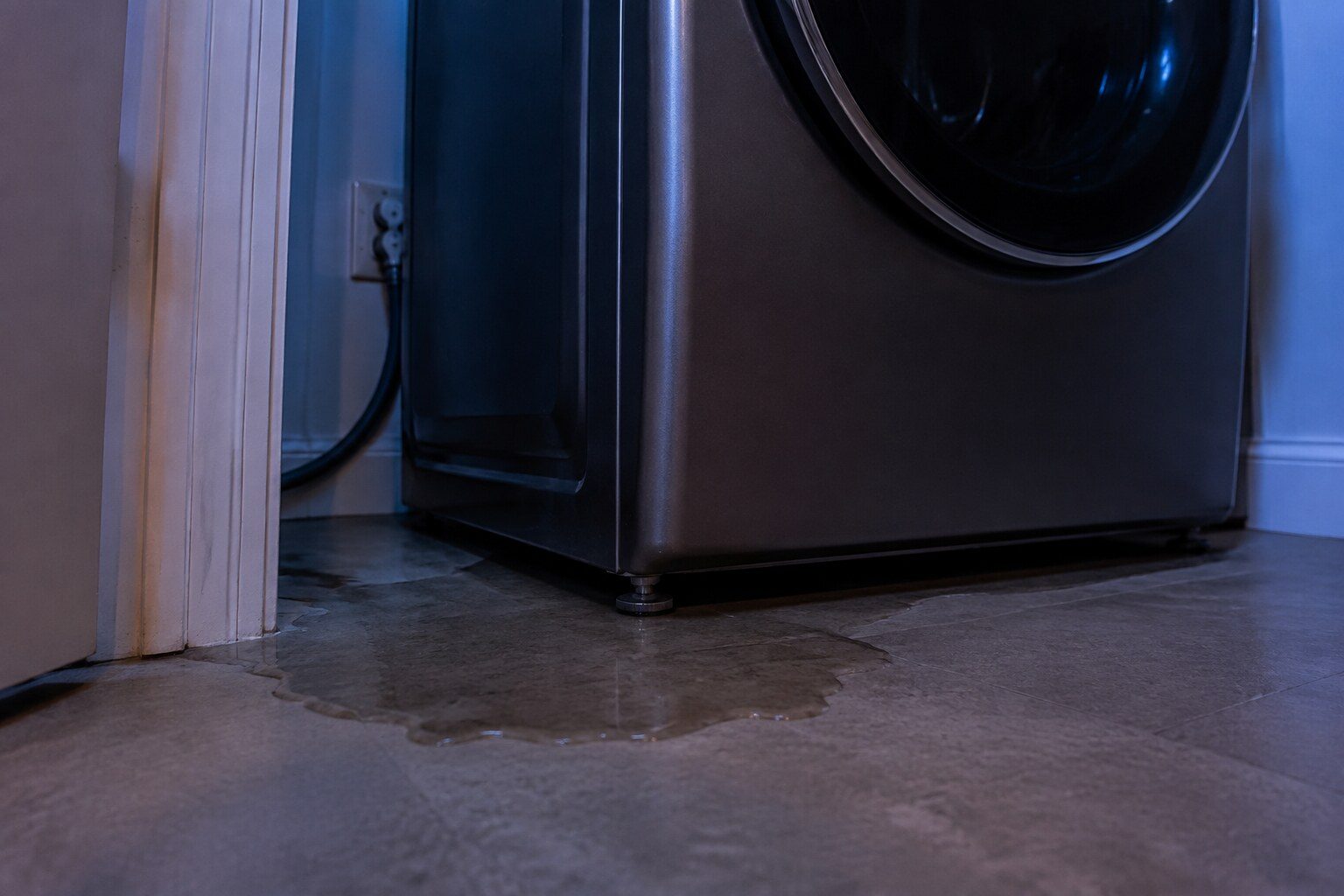
- “A leak code with nothing on the floor is early warning, not a mistake”
- “When the water appears in the cycle tells you where it comes from”
- “Detergent foam produces this on a machine that is not leaking at all”
Symptom
Samsung washer leaking
Samsung's 1E and LC family is the leak and level sensing, and it sits low in the cabinet — so it finds moisture well before your floor does. A leak code with a dry floor is not a false alarm, it is an early one, and that is the cheap end of this repair.
- From $95 diagnostic, credited to the repair
- 59 cities and neighborhoods covered
- OEM parts available on order
- In writing the price, before anything is opened
Five ordinary causes
What this usually turns out to be
Cheapest and commonest first, which is also the order we check them in. They sit hundreds of dollars apart, and only the unit settles which one is yours.
-
The door boot
The rubber seal at the front. It collects water at the bottom and splits there.
Washer leak repair from $155 -
Hoses and connections
Fill hoses, the drain hose and the internal connections. The cheap end and the commonest.
Washer leak repair from $155 -
Excessive suds
Foam escaping past a seal that would hold water perfectly well. Not a leak — a detergent dose.
Diagnostic visit from $95 -
The pump seal
Shows on spin, when the pressure is highest.
Washer leak repair from $155 -
The dispenser
Blocked with dried softener, so it overflows at the front.
Washer leak repair from $155
In five minutes
Before you call anybody
None of it needs tools, and all of it makes the visit shorter.
-
01
Note when in the cycle it happens
Fill, wash or spin. Three different answers.
-
02
Look at the bottom of the door boot
Pull it back gently and look at the lowest point, where water sits.
-
03
Check the detergent dose
Foam over the top of a seal looks exactly like a leak.
-
04
Pull the machine out and look behind
A hose connection weeping at the back reaches the front of the floor.
How it shows up
What people describe when they call
A shortcut
Narrow it down before anybody arrives
A description of the behaviour leaves a few possible causes. A code names the subsystem before anybody opens anything, which is why it is worth photographing before it clears.
If there is no code at all
BNDL
WA45T3200AW
WA46CG3505AVA4
WA46CG3505AWA4
WA47CG3500AVA4
WD53DBA900HBA1
WF53BB8700AVUS
WH46DBH100EWA3
WW25B6900AW
The data plate is inside the cabinet, upper left wall or behind the grille. All models
In more detail
About Samsung washer leaking
Watch a cycle and note when
A leak on fill is a hose, a valve or the dispenser. A leak during wash is the door boot or the tub. A leak on spin is the pump seal or a hose under pressure. Ten minutes of watching narrows this more than any amount of dismantling.
What it usually means, by the kind of Samsung appliance
Samsung sells one appliance in several forms, and the same behavior points at different things on each of them. A built-in side-by-side and an integrated column are not the same service situation, and a dual-fuel range and an induction range fail in different halves.
- Front load — The door boot is the classic, and it fails at the bottom where it holds water.
- Top load — Hoses, the pump seal and the dispenser are the usual sources.
- Stacked or in a closet — The water often appears somewhere other than where it starts, so the machine has to be pulled out to be sure.
The sensor is not lying to you
Samsung puts the level and leak sensing low in the cabinet, which means it detects moisture in the base before there is anything to see in the room. Owners regularly assume a leak code with a dry floor is a malfunction of the sensor. It is usually the opposite: it is the machine catching a weep at the point where the repair is still a hose.
Foam is not water
A drum full of suds behaves like a drum that is overfull, and foam will climb past a seal that water would never get through. That is why the detergent dose is on the checklist for a leak: it is free, it is common, and it explains a machine that leaks only on certain cycles.
This article is based on:
- Official manufacturer documentation
- Internal repair procedures
- Technician repair history
- Company quality standards

Before you book
Questions about Samsung washer leaking
It only leaks with a big load.
That fits the door boot or a level problem: more water, higher in the drum, and more movement. It also fits too much detergent, since a big load usually gets a bigger dose.
There is water under the machine but the floor in front is dry.
Then it is coming from the back or the base rather than the door — hoses, the pump or the tub. The machine has to come out for that one.
Where we do it
Across Miami-Dade, Broward, and Palm Beach
Same terms everywhere we go: an on-site diagnostic first, the price agreed in writing, and the exact figure confirmed once we have seen the unit.
Neighborhoods people ask for by name