Safety & Risks
How Long Food Stays Safe in a Refrigerator Without Power
A closed refrigerator holds food safely for about four hours. A closed freezer holds for about forty-eight hours if it is full, and about twenty-four if it is half full — a full freezer holds cold far better than an empty one, because the frozen food is itself the thermal mass. Those numbers assume the doors stay shut, and every opening costs a meaningful fraction of them. When power returns, do not judge food by smell or appearance: judge it by temperature. Anything perishable that has been above 40°F for more than four hours goes, and frozen food that still has ice crystals in it and is at or below 40°F can be refrozen, though the texture will suffer. A Samsung refrigerator may show a code when it comes back — 88 88, or one of the voltage codes — and that is the cabinet reporting the interruption rather than a failure.
The full guide
How long is food safe in fridge without power? Two clocks, and one rule that beats both
The numbers are worth knowing before you need them, because the moment you need them the power is off and you cannot look them up.
A refrigerator: about four hours. Closed, from the moment the power goes.
A freezer: about forty-eight hours if it is full, about twenty-four if it is half full.
The rule that matters more than either number is simpler: keep the doors shut. Every opening dumps the cold air out and pulls warm room air in, and in a South Florida house in summer that room air is both hot and wet. Two or three casual openings can halve the window.
Why a full freezer holds so much longer
This surprises people, and it is worth understanding because it is actionable.
The cold in a freezer is not stored in the air — air holds almost no heat. It is stored in the frozen mass: the food, the ice, anything solid and cold. That mass has to absorb a great deal of energy before it can warm up, and while it is doing so it keeps everything around it cold.
An empty freezer has almost nothing doing that job. A full one has forty pounds of it.
Which gives you a genuinely useful thing to do ahead of a storm: fill the gaps. Containers of water, bottles, anything that will freeze. It costs nothing, it doubles the window, and the water is useful afterwards regardless.
When the power comes back: judge by temperature
This is the part people get wrong, and it is the part that matters.
Do not judge food by how it smells or looks. The organisms that cause food poisoning do not announce themselves that way. Something that has been at 55°F for six hours can look and smell entirely normal and be unsafe.
Judge it by temperature. The threshold is 40°F. Anything perishable that has been above 40°F for more than four hours goes: raw and cooked meat, poultry, fish, dairy, eggs, cut fruit and vegetables, soft cheese, leftovers, anything with an opened sauce in it.
Frozen food is more forgiving. If it still has ice crystals in it and is at or below 40°F, it can be refrozen. The texture will suffer — ice crystals rupture cell walls and the food will be wetter and softer when it is eventually cooked — but the safety case is fine. Food that has fully thawed and been above 40°F for more than two hours does not get refrozen.
The practical version of all this: keep an appliance thermometer in the refrigerator permanently. When the power comes back you can answer the question with a number rather than a guess, and that is worth about eight dollars.
What harder to judge looks like
A few specific cases, because they come up.
Hard cheese, butter, jams, most condiments. Generally fine — low moisture, high acid or high salt, and they are not where the risk lives.
Anything in a sealed jar that has never been opened. Usually fine.
Breast milk, infant formula, anything for somebody immunocompromised. Do not stretch the rules. The margins that are acceptable for a healthy adult are not the right margins here.
A freezer full of food that thawed and refroze while you were away. If you cannot establish how long it was warm, you cannot establish that it is safe. That is a hard conversation with a full freezer and it is still the right answer.
What a Samsung does when the power returns
Two things that alarm people and are not problems.
Every icon on the panel lights up at once. That is the cabinet running its self-check after being plugged in or coming back from an outage. Samsung says plainly that it is normal. It looks exactly like an appliance in distress and it is the opposite.
A code appears. Usually a power or voltage code — Samsung's 88 88, or 83E, 85E or 86E, and on other appliances a PF-style power failure report. Those say the supply was interrupted, which you already knew. Cut power at the breaker for sixty seconds and restore it, and they generally clear.
If a voltage code keeps returning with no further outages, that is worth having looked at — it means the supply reaching the appliance is not stable, and that is upstream of the refrigerator.
And one thing to check before you call anybody
If the cabinet has power, is lit up, and is not getting cold again after several hours, look at the display for OF OF, O FF, or temperature bars scrolling across it.
That is Cooling Off mode — Samsung's showroom mode, where the panel and the light work and the compressor is deliberately off. It is triggered by holding two buttons, and a power interruption is exactly the kind of moment when somebody stands at the panel pressing things to see whether it is working.
Holding the top two buttons on the left for five to eight seconds, until a chime sounds that is different from a single press, clears it. Free, and worth checking before a service call.
Preparing, in a state where this happens
Three things, done in advance, that make the difference.
A thermometer in each compartment. Then the four-hour question has a factual answer.
A full freezer. Containers of water in the gaps.
Knowing where your breaker is, and which one it is. Because when the power comes back, everything in the house comes back at once, and being able to isolate an appliance you are unsure about is useful.
None of that is appliance repair. All of it is what we would do, and this is a state where it is worth doing before the season rather than during it.

Questions people ask about this
Can I refreeze food that has thawed?
If it still has ice crystals in it and it is at or below 40°F, yes — the safety case is fine and the texture will be worse. If it has fully thawed and been above 40°F for more than two hours, no. Meat and fish are where this matters most.
Does a full freezer really hold longer?
Substantially. The frozen food is itself the thermal mass keeping everything else cold, so a full freezer roughly doubles the safe window compared with a half-empty one. Ahead of a storm, filling gaps with containers of water and freezing them is a genuinely useful thing to do.
My refrigerator shows a code now the power is back.
Very likely a voltage or power code — Samsung's 88 88, 83E, 85E or 86E, or PF-style reports on other appliances. Those mean the supply was interrupted, which you already know. Cut power at the breaker for sixty seconds and restore it; if the code returns without another outage, the supply is worth having measured.
The refrigerator is running but it is not getting cold again.
Give it several hours before drawing conclusions — a cabinet that has been off for a day does not recover in twenty minutes. If it is still warm the next day, check the display for Cooling Off mode first: a power interruption is one of the moments people accidentally trigger it while pressing buttons.
Safety & Risks
More guides like this one
-
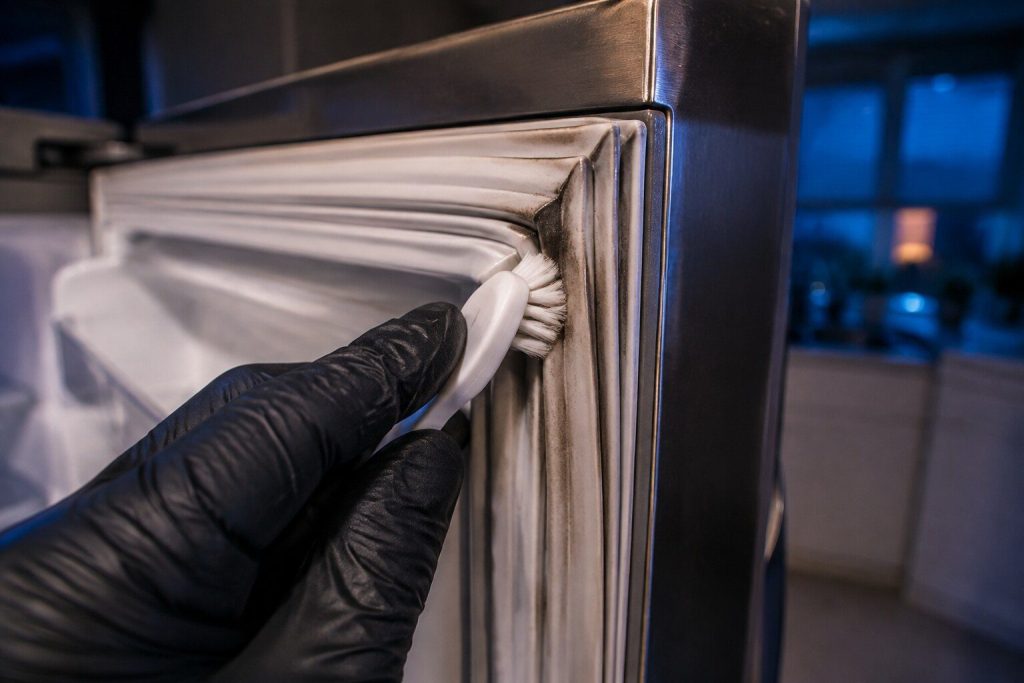
Mold on a Door Seal: Removing It, and Stopping It Coming Back
It comes off with warm soapy water and patience. What matters more is where it keeps coming back, because that is telling you where the seal has stopped making contact.
Read more
Tell us the model number and what it is doing.
This article is based on:
- Official manufacturer documentation
- Internal repair procedures
- Technician repair history
- Company quality standards